There’s no denying that static drills have their place in football practice, and it’s important to hammer home the basics of the game, especially in younger players who are still in the early stages of getting to grips with it. However, if your aim is to build smart, situationally aware, and, most importantly, skilled players, then three-, four-, and five-a-side games are the best coaching tools. Here’s why.
Improving Decision-Making
The mind is like a muscle in that it needs to be exercised regularly to work effectively, and static drills simply don’t do much in this regard. Small-sided games, on the other hand, present players with many moment-to-moment decisions, meaning they’ll be thinking tactically and having their perceptions pushed further and further throughout.
Crucially, it’s the low player count that helps here as much as the game-based format. When there aren’t as many people involved, each participant gets more time on the ball, and so it’s good not only for decision-making but also for establishing and reinforcing team communication and bonds.
You’ll see if you check out odds for soccer betting that the best performing professional sides are filled with smart stars who can make snap decisions without dithering. That same acuity can be nurtured in young amateurs with small games.
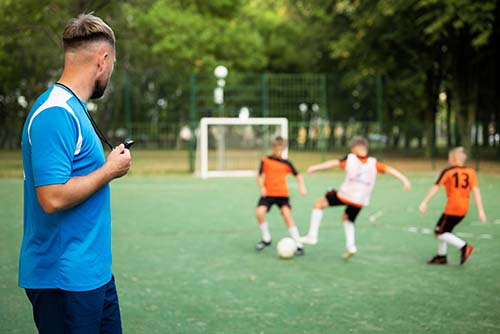
Making Fitness Fun
Effective performance on the football pitch requires a base level of fitness that novice players don’t necessarily have when they first turn up at practice. Static drills can be good for working on this, but if the exercise is boring and overtly intended, it’s harder to keep people committed.
The better option is to use small-sided games as a covert way to make fitness fun, since they’re essentially a form of high-intensity interval training (HIIT) that doesn’t feel nearly as tedious or tiring. Because everyone’s involved with the game for most of the time the ball’s in play, heart rates are high, and boredom levels are low.
Helping Players Cope with Transitional Moments
Static drills break down aspects of the game so they can be focused on and perfected in isolation, but football is all about linking these different skills and disciplines. Small-sided games put the focus on these transitional moments, especially when the ball is lost, and an attacking team has to switch to a defensive style of play on the fly. Again, it’s a way of building mental dexterity that leaves players smarter than they were, and avoids full-team game scenarios from flooring them when they finally arise.
Highlighting Real Situations
Lastly, there’s the learn-by-doing upside of using small-sided games as part of regular soccer practice, rather than overemphasising static drills. Because football is an open-loop sport and conditions change second by second, you need authentic game situations on the training pitch so the stakes feel real.
There’s definitely a balance to strike between using static drills and setting up small-sided games. If you’re keen to keep younger players engaged, the latter will help, and it’s also a way to put skills acquired through drills into practice.
 Soccerdrills.de
 Coachshop.de - Our Coach-Shop