The off-season is a trap for many soccer players. The schedule clears, the pressure lifts, and it becomes easy to shut everything down. But the players who return to pre-season in the best shape are the ones who kept moving when no one was watching.
You don't need a full gym or a training pitch to maintain fitness. A well-structured home training plan will keep your aerobic base, leg strength, and mobility intact until the season picks back up.
Why Off-Season Fitness Matters
Soccer demands a high aerobic engine. Outfield players can cover 10 to 13 kilometers per match, much of it at moderate to high intensity. Letting that base erode over weeks of inactivity means spending the first month of pre-season just clawing it back.
The off-season is not about peaking. It is about maintaining enough fitness that your body is not starting from zero when training resumes.
Building Your Cardio Base at Home
Cardio is the foundation of off-season conditioning. Without regular field sessions, you need practical ways to keep your heart rate up and your legs working consistently.
Cycling as a Soccer Conditioning Tool
Cycling is one of the most effective cardio tools available to soccer players. It builds leg endurance, improves aerobic capacity, and places very little stress on the joints compared to running. That makes it ideal during a recovery phase when your body needs a break from high-impact activity.
For players building a home cardio setup without much floor space, compact exercise bikes offer an efficient way to get consistent aerobic training on a stationary bike without dedicating an entire room to fitness equipment.
Aim for three to four cycling sessions per week, ranging from 20 to 45 minutes. Keep the effort conversational on most days, with one slightly harder session per week to maintain sharpness.
Jump Rope and HIIT Work
Jump rope is cheap, portable, and highly effective. Even 10 to 15 minutes of consistent skipping raises your heart rate significantly and improves foot coordination at the same time.
For higher-intensity days, short HIIT circuits work well. Combine exercises like squat jumps, high knees, and lateral shuffles into 20-second bursts with brief rest periods. Keep sessions under 25 minutes to avoid overloading without adequate recovery.
Strength Work Without a Gym
Leg strength is what keeps soccer players powerful through 90 minutes. Maintaining it at home does not require weights or machines.
Bodyweight Lower Body Training
Single-leg exercises are the most valuable tool in your home arsenal. They build strength, address muscle imbalances, and challenge balance in ways that carry over directly to match situations.
Focus on these movements:
- Bulgarian split squats, performed slowly with a three-second descent
- Single-leg Romanian deadlifts for hamstring strength and stability
- Step-ups using a sturdy chair or low box
- Lateral lunges to target the hip abductors used in defending and changing direction
Three sets of 10 to 12 reps per leg, two to three times per week, is enough to maintain strength without causing excessive soreness.
Core Stability
A strong core protects the lower back and improves power transfer when striking the ball or holding off an opponent. You do not need a single crunch to achieve this.
Prioritize anti-rotation and anti-extension exercises. Planks, dead bugs, side planks, and resistance band Pallof press variations are all highly effective. Two to three sets of each, held for 20 to 40 seconds, performed three times per week, is sufficient.
Mobility and Recovery
This is where most players fall short. The off-season is the ideal time to address tightness and imbalances that build up during a long, demanding season.
Hip and Hamstring Flexibility
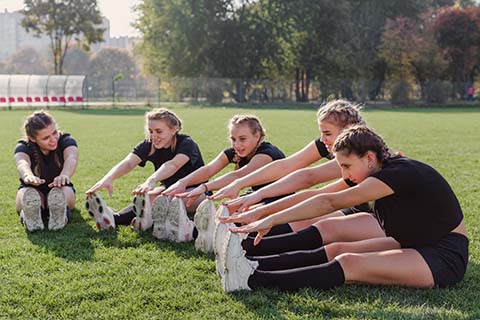
Soccer players tend to accumulate tightness in the hip flexors, hamstrings, and adductors. Spending 10 to 15 minutes each day on targeted stretching pays real dividends when regular training resumes.
Focus on the 90-90 hip stretch, pigeon pose, and seated hamstring holds. Hold each position for at least 45 seconds rather than short, bouncing repetitions. Consistency matters far more than intensity.
Sleep and Nutrition
Training adaptations happen during recovery, not during the session itself. Protecting your sleep during the off-season ensures the work you are putting in actually sticks.
Aim for seven to nine hours per night. Keep protein intake consistent at around 1.6 to 2.0 grams per kilogram of bodyweight per day to preserve muscle mass when training volume drops.
A Simple Weekly Structure
A basic weekly template prevents the off-season from becoming unstructured and unproductive:
- Monday: Cycling or HIIT cardio plus core work
- Tuesday: Bodyweight lower body strength session
- Wednesday: Active recovery, mobility, and stretching
- Thursday: Cycling or jump rope plus core work
- Friday: Full lower body strength session
- Saturday: Light cardio or recreational activity
- Sunday: Full rest
Adjust based on how your body responds. The goal is consistency, not perfection.
The Mindset Shift
The off-season is not a reward for surviving the season. It is an investment in the next one. Players who approach home training seriously do not just maintain fitness; they come back stronger, more mobile, and mentally sharper than teammates who went completely inactive.
You do not need a lot of space or a significant budget to make it work. You need a clear plan, a few square meters of floor space, and the discipline to show up for yourself when no one else is watching.
 Soccerdrills.de
 Coachshop.de - Our Coach-Shop